
Z-Score CalculatorCalculate Z-scores and percentiles, or find values from Z-scores using the standard normal distribution.

Z-Score Calculator
Calculate Z-scores and percentiles, or find values from Z-scores using the standard normal distribution.
Choose Mode
Calculate Z-score from a value, or find a value from a Z-score.
Enter Parameters
Input the value (or Z-score), mean, and standard deviation.
View Results
See Z-score, percentile, and left/right tail probabilities.
What Is Z-Score Calculator?
The Z-Score Calculator works with the standard normal distribution to convert between raw values and standardized scores. A Z-score tells you how many standard deviations a value is from the mean. In one mode, enter a value with its distribution's mean and standard deviation to find the Z-score and percentile. In the other mode, enter a Z-score to find the corresponding value and probabilities. The calculator shows cumulative probabilities for both tails — P(X < x) and P(X > x) — which are essential for hypothesis testing, quality control, and understanding data distributions.
Why Use Our Z-Score Calculator?
- Bidirectional: value → Z-score or Z-score → value
- Shows percentile rank and cumulative probabilities
- Built-in standard normal CDF approximation
- Essential for statistics, quality control, and data analysis
Common Use Cases
Standardized Testing
Convert test scores to Z-scores for comparison across different tests.
Quality Control
Determine how many standard deviations a measurement is from specification.
Statistics Coursework
Solve Z-score problems for statistics classes.
Data Analysis
Identify outliers and understand data distribution.
Technical Guide
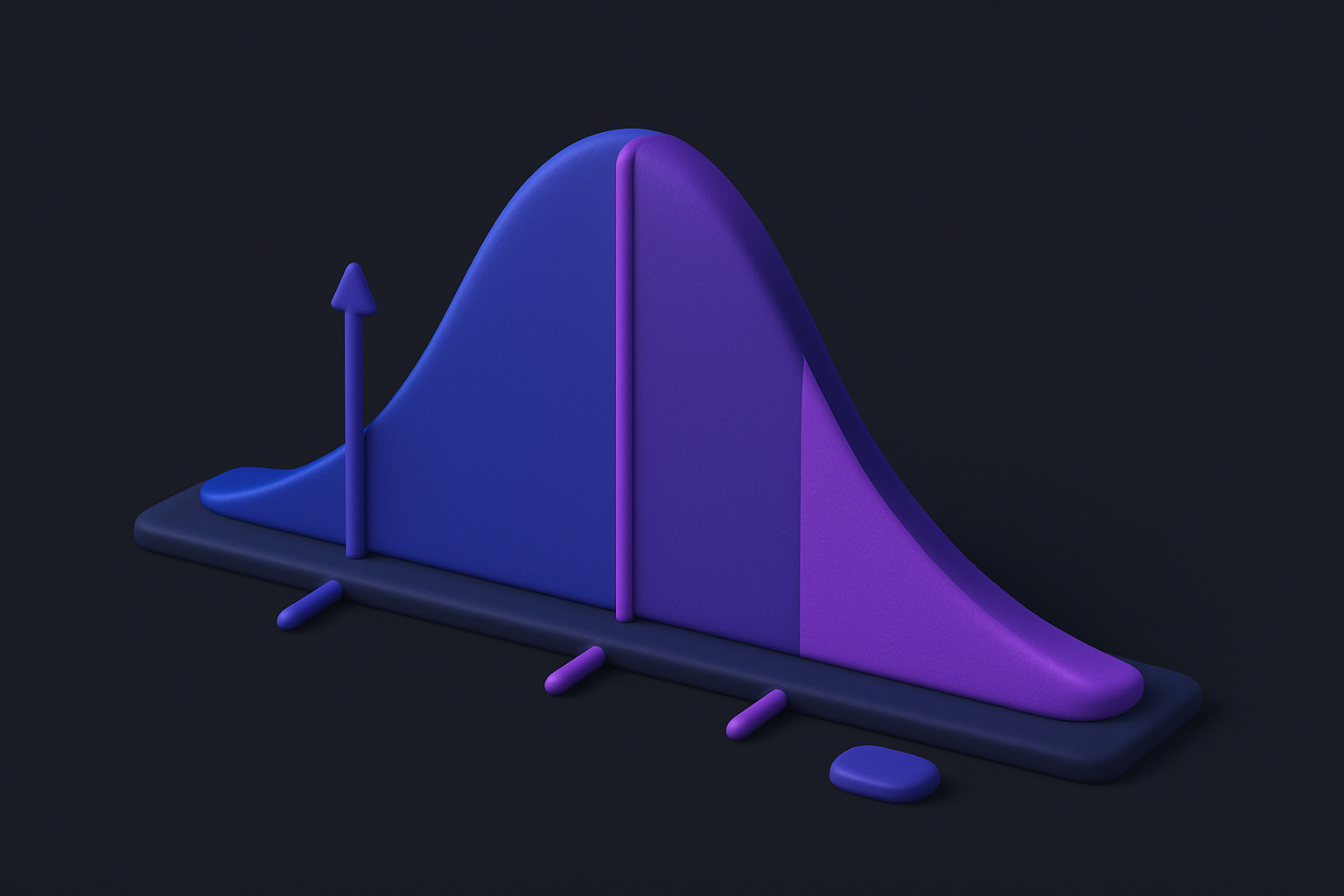
The Z-score formula is: Z = (X - μ) / σ, where X is the value, μ is the population mean, and σ is the standard deviation. The inverse is: X = Z × σ + μ. The cumulative probability P(Z ≤ z) is computed using the Abramowitz and Stegun approximation of the error function, which is accurate to 7 decimal places. The percentile rank equals P(Z ≤ z) × 100. In a standard normal distribution (μ=0, σ=1): ~68% of data falls within ±1σ, ~95% within ±2σ, and ~99.7% within ±3σ (the empirical rule).
Tips & Best Practices
- 1Z = 0 means the value equals the mean; Z > 0 means above average; Z < 0 means below
- 2About 68% of values fall between Z = -1 and Z = +1 (68-95-99.7 rule)
- 3Z-scores above 3 or below -3 are typically considered outliers
- 4Z-scores allow comparison between different distributions with different scales
Related Tools

P-Value Calculator
Calculate p-values from Z or t test statistics with one-tailed and two-tailed options.
 Math & Calculators
Confidence Interval Calculator
Calculate confidence intervals from summary statistics or raw data with multiple confidence levels.
Math & Calculators

Sample Size Calculator
Calculate required sample size for surveys based on confidence level, margin of error, and population.
Math & Calculators

Percentage Calculator
Calculate percentages, percentage change, and what percent one number is of another.
Math & Calculators

Fraction Calculator
Add, subtract, multiply, and divide fractions with automatic simplification.
Math & Calculators

Scientific Calculator
Full-featured scientific calculator with trigonometry, logarithms, factorials, and more.
Math & CalculatorsFrequently Asked Questions
QWhat is a Z-score?
QWhat is the 68-95-99.7 rule?
QHow do I interpret percentiles?
QCan Z-scores be negative?
QWhat Z-score corresponds to the 95th percentile?
About Z-Score Calculator
Z-Score Calculator is a free online tool from FreeToolkit.ai. All processing happens directly in your browser — your data never leaves your device. No registration required. No ads. Just fast, reliable tools.