
Capacitance ConverterConvert between farads, millifarads, microfarads, nanofarads, and picofarads.
Capacitance Converter
Convert between farads, millifarads, microfarads, nanofarads, and picofarads.
Enter capacitance
Type the capacitance value.
Select units
Choose source and target capacitance units.
Get the result
Converted capacitance appears instantly.
What Is Capacitance Converter?
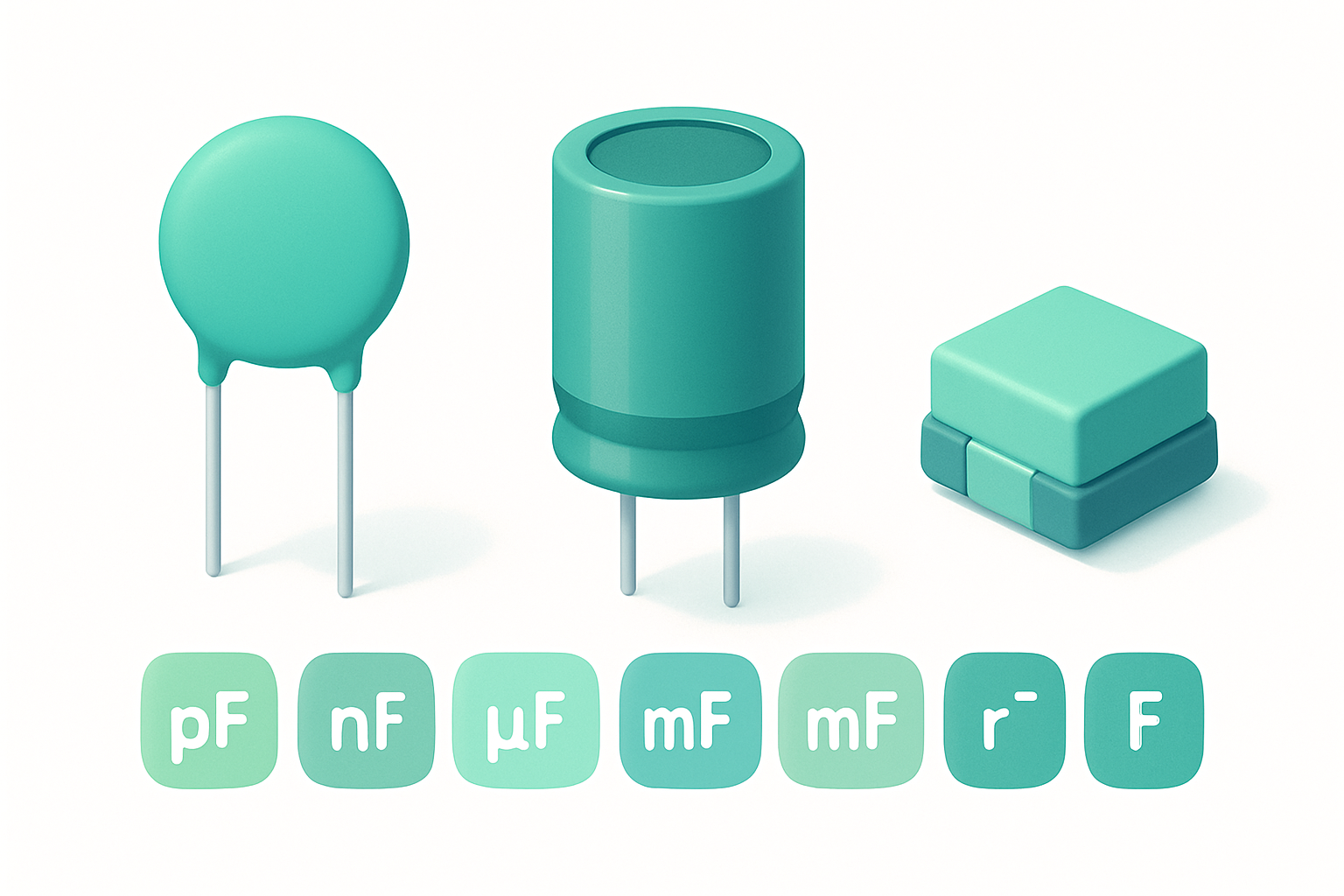
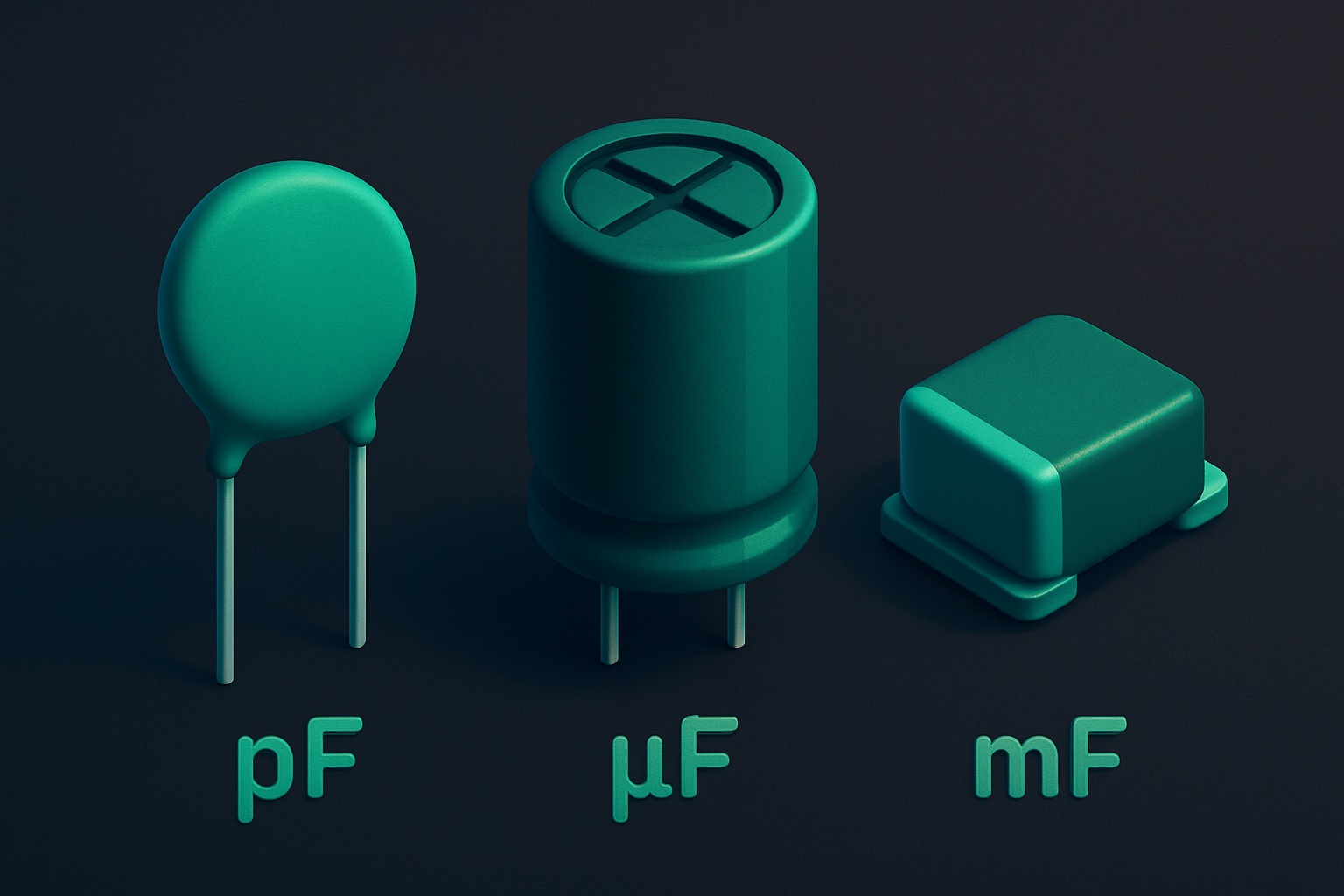
A capacitance converter translates between different scales of the farad, the SI unit of electrical capacitance. One farad is the capacitance that stores one coulomb of charge at one volt — an enormous value in practical electronics. Most real components range from picofarads (pF, for RF circuits) through nanofarads (nF) to microfarads (µF, for power supply filtering). Millifarads (mF) and farads are encountered in supercapacitors and energy storage applications. This converter handles the five most common capacitance scales used in electronics design.
Why Use Our Capacitance Converter?
- Covers pF to F — the full range of practical capacitance values.
- Essential for reading capacitor markings and datasheets.
- Real-time conversion for circuit design calculations.
- Quick reference table.
Common Use Cases
Circuit Design
Convert between µF, nF, and pF for component selection.
Capacitor Selection
Translate between different notation styles used by manufacturers.
RF Engineering
Work with pF values for antenna matching and filter design.
Power Electronics
Convert between µF and mF for power supply capacitor sizing.
Technical Guide
The farad (F) is defined as C = Q/V — the charge stored per volt of potential difference. • 1 F = 1,000 mF • 1 mF = 1,000 µF • 1 µF = 1,000 nF • 1 nF = 1,000 pF So: 1 F = 10⁶ µF = 10⁹ nF = 10¹² pF Capacitor marking conventions: • Ceramic capacitors often use a 3-digit code: first two digits are significant figures, third is the multiplier (in pF). "104" = 10 × 10⁴ pF = 100,000 pF = 100 nF = 0.1 µF. • Electrolytic capacitors are typically marked in µF. Common values: • Decoupling capacitor: 100 nF (0.1 µF) • Power supply filter: 100-10,000 µF • Supercapacitor: 1-3,000 F
Tips & Best Practices
- 1Ceramic cap code "104" = 100 nF = 0.1 µF. The third digit is the power of 10 in pF.
- 21 µF = 1,000 nF = 1,000,000 pF. Memorize these three scales.
- 3A "1 farad" capacitor is enormous — only found in supercapacitors.
- 4Standard capacitor values follow the E-series (E6, E12, E24) with preferred values.
Related Tools
Inductance Converter
Convert between henries, millihenries, microhenries, and nanohenries.
 Unit Converters

Electric Current Converter
Convert between amperes, milliamperes, microamperes, and kiloamperes.
Unit Converters

Voltage Converter
Convert between volts, millivolts, microvolts, kilovolts, and megavolts.
Unit Converters

Frequency Converter
Convert between Hertz, kilohertz, megahertz, gigahertz, and RPM.
Unit Converters
Length Converter
Convert between millimeters, centimeters, meters, kilometers, inches, feet, yards, miles, and nautical miles instantly.
Unit Converters
Weight Converter
Convert between milligrams, grams, kilograms, ounces, pounds, metric tons, and stones in real time.
Unit ConvertersFrequently Asked Questions
QHow many nanofarads in a microfarad?
QWhat does the 3-digit code on a ceramic capacitor mean?
QHow big is a farad?
QWhat is a typical decoupling capacitor value?
About Capacitance Converter
Capacitance Converter is a free online tool from FreeToolkit.ai. All processing happens directly in your browser — your data never leaves your device. No registration required. No ads. Just fast, reliable tools.